Types of surfboards
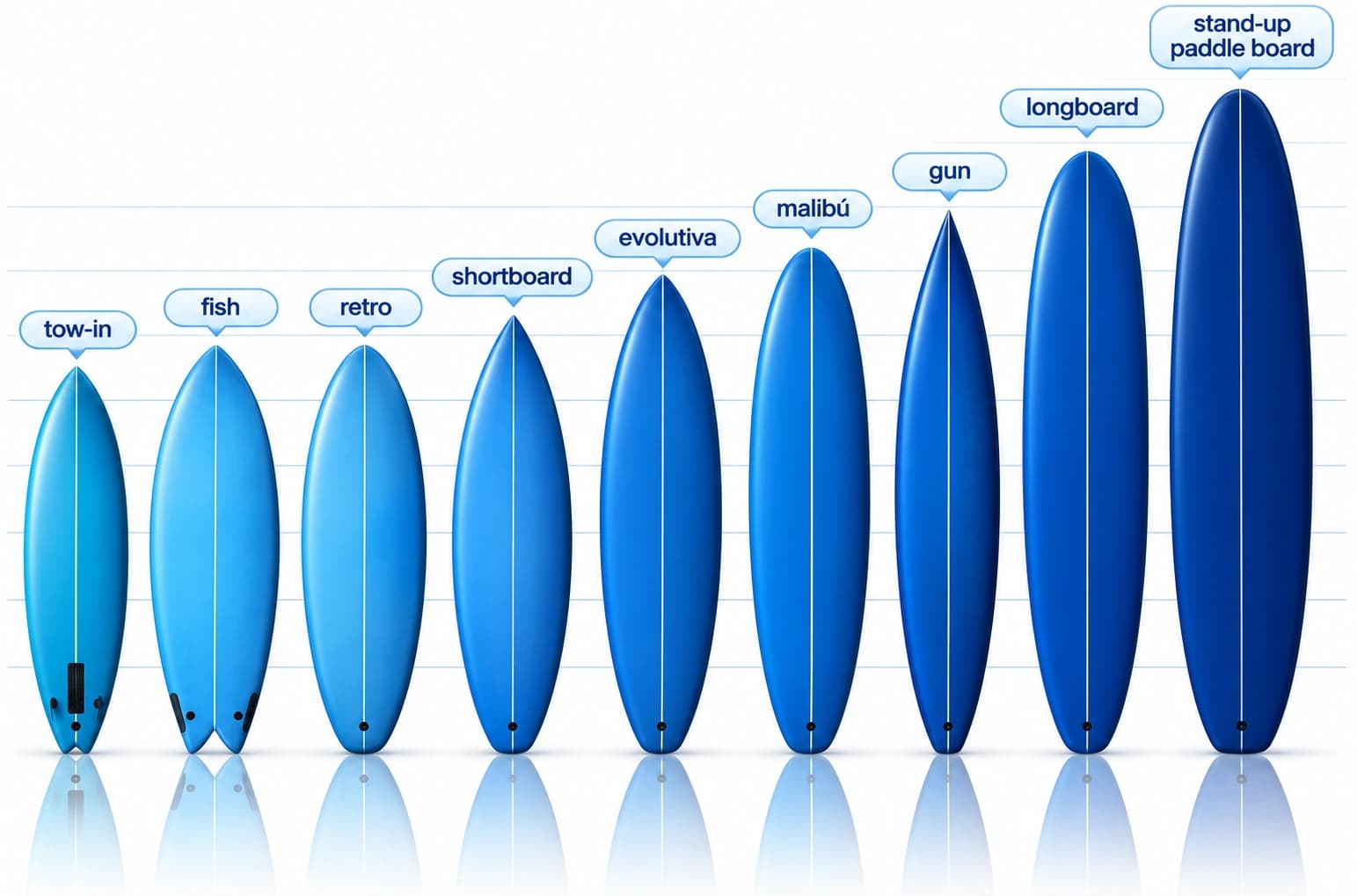
Each type of board is designed for a different level and wave conditions. These are the 9 most common types, ordered from smallest to largest.
Tow-in
A short, narrow, heavy board with very little buoyancy, designed to be towed behind a jet ski. It has foot straps and is used in giant waves that can't be caught by paddling.
Fish
A short, wide board with a swallow tail and plenty of volume. It works really well in small, weak waves, adding speed and looseness to turns.
Retro
A board inspired by the classic designs of the 60s and 70s, with a rounded nose, plenty of volume and, usually, a single fin. It offers a smooth glide, ideal for small to medium waves.
Shortboard
A short, narrow board with a thinner tail. Designed for intermediate to advanced surfers looking for manoeuvrability and performance in quality waves.
Evolution board
A board in between a shortboard and a funboard, with a bit more volume, width and thickness. Designed for surfers who already have the basics down and want to keep progressing, as it's still manoeuvrable but paddles more easily.
Malibu
A long board, like a shorter longboard, with a rounded nose and plenty of volume. It allows cross-stepping along the board and is a great option for learning and surfing small waves in a classic style.
Gun
A long, narrow board with a pointed tip at both ends. Designed for big waves, it lets you pick up speed quickly and stay in control on powerful faces.
Longboard
A long, wide board with plenty of volume. It paddles easily, catches almost any wave, and allows for a more classic, relaxed style of surfing, ideal for beginners and small-wave days.
Stand-up paddle board
The longest, widest and most voluminous board of them all. You paddle it standing up with a paddle, letting you catch almost any wave, even with barely any swell, and it's also used for paddling on flat water.